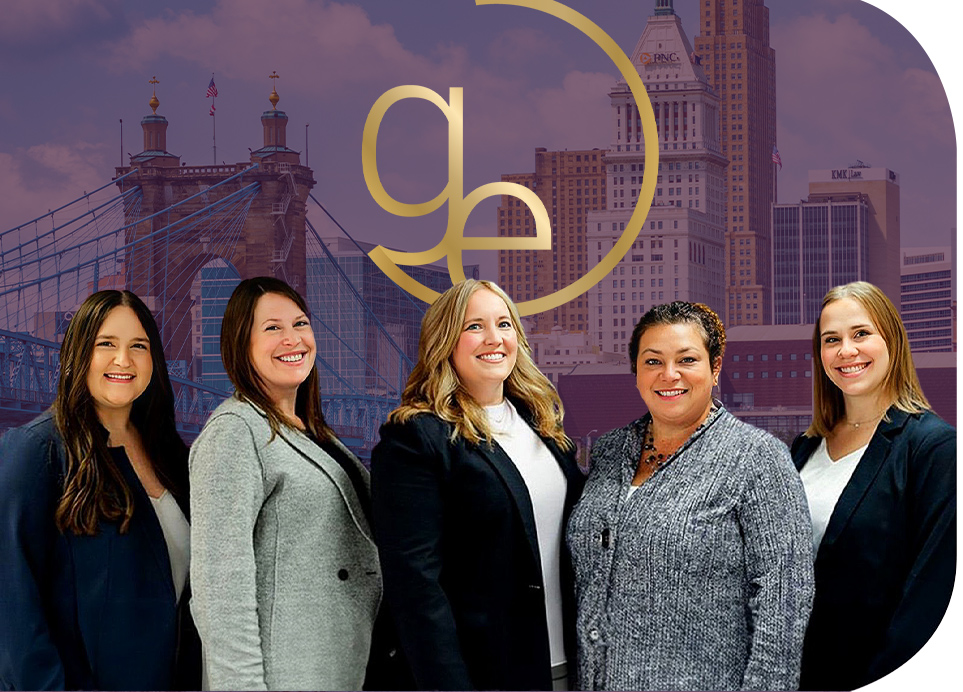
Cincinnati Divorce Lawyer
Direct Attorney Access for Your Cincinnati Divorce
Ending a marriage can require decisions about property, support, parenting responsibilities, and temporary arrangements while a case is pending. At Goldberg Evans, you can speak directly with an attorney about the path forward.
We explain the legal options available for your circumstances, including mediation, collaborative divorce, dissolution, and litigation. These processes differ in how disagreements are handled and whether a court must decide unresolved issues.
Considering divorce in Cincinnati? Schedule a consultation online or call (513) 927-9759 to speak directly with one of our divorce attorneys about your options.
Understanding Divorce Types in Cincinnati
Traditional divorce can involve court resolution when spouses have not resolved all issues. Dissolution of marriage requires mutual agreement before filing, while collaborative divorce gives spouses and their attorneys a structured process for negotiating an agreement outside court.
One of the first questions we address is whether your case is likely to be contested or uncontested. In an uncontested divorce or dissolution, both parties reach agreement on material issues before final approval, including property and debt division, spousal support, and parenting arrangements. A contested divorce leaves one or more issues for negotiation, motion practice, or court determination. Disagreements about financial disclosure, parenting time, support, or property can affect the process and level of court involvement.
What Is Collaborative Divorce?
Collaborative divorce is a process in which both spouses and their attorneys commit to pursuing settlement outside court. The parties sign a participation agreement and work through negotiations without asking a judge to decide disputed terms. Both Trista P. Goldberg and Shawn M. Evans are trained in the collaborative divorce process, and Trista Goldberg is also a trained Collaborative Law Attorney and Mediator.
Collaborative divorce depends on voluntary, constructive participation and the availability of essential financial information. It may not fit every situation, particularly when meaningful negotiation cannot proceed safely or transparently.
What Happens in Mediation?
Mediation is a voluntary process for resolving disputes. A mediator facilitates discussion, helps parties develop options, and doesn’t act as a judge or decide the dispute. At Goldberg Evans, our mediators are trained divorce lawyers acting neutrally to assist parties in reaching settlements in family law situations involving asset division, child custody agreements, and future planning.
Mediation may help parties address:
- Parenting plans that reflect a family’s particular needs.
- Property and debt division through facilitated discussion of available options.
- Spousal support and other financial terms that require resolution.
- Agreements for court review when the parties reach terms that must be included in a final order.

Stories From Families We’ve Helped
What Our Clients Have to Say About Working with Us.
-
“Her assistance was personable, valuable, and far beyond professional.”- Joe H.
-
“I would definitely recommend Shawn Evans.”- Leah P.
-
“She took the time to help me understand the legal process so I could feel confident in my case.”- Priya S.
-
“I’ve needed an attorney who was not just versed in the law but one who would bother to really understand the dynamic and put the time and thought into resolutions that would protect me and my children.”- Julie G.
-
“I always felt my case was a priority and my thoughts and concerns heard.”- Jan T.
-
“She presents with tenacity and is brilliant, skillful, and masterful in her representation.”- Robin T.
-
“I was met with kindness and empathy throughout the entire process, but also with strength, support, and an admirable amount of transparency with possible outcomes.”- Jessica D.
-
“I hope this review helps someone in their search for a top notch lawyer. You would not regret choosing Trista and her team!”- Scott W.
Family Law Focus & Direct Attorney Access Since 2009
At Goldberg Evans, Trista P. Goldberg and Shawn M. Evans represent individuals and families facing divorce and other family law challenges. Both founding partners have practiced family law since 2009 and established a smaller practice after gaining experience at larger firms. You can contact us to discuss your family law matter.
We listen to each client’s story and provide representation based on the circumstances at hand. Our attorneys explain the legal rights, responsibilities, and processes involved in ending a marriage.
Our approach includes:
- Direct attorney access when you contact our firm about your family law matter.
- Family law experience built through the focused work of our founding attorneys since 2009.
- Personal attention informed by the larger-firm experience that led our founders to create a smaller practice.
Financial & Custody Considerations During Divorce in Cincinnati
Divorce may raise interconnected financial and parenting questions. Our work includes spousal support, asset division, and parenting plans, with careful attention to Ohio law.
Our approach includes an assessment of marital and separate property, liabilities, income, and financial disclosures. Trista Goldberg’s practice includes complex financial tracing and business valuations in high-asset divorce matters. Parenting decisions address parental rights and responsibilities and parenting time according to the child’s best interests, while spousal support is determined by the parties’ financial circumstances and factors required by Ohio law.
Divorce matters may involve:
- Division of assets and debts under Ohio law.
- Parental rights and parenting time based on the family’s circumstances.
- Assessment of spousal support based on the parties’ financial circumstances.
- Development of a parenting plan for issues involving children.
How to File for Divorce in Cincinnati, Ohio
Cincinnati divorce matters are generally filed through the Hamilton County Court of Domestic Relations, which hears marital and non-criminal domestic disputes. Accurate pleadings, financial information, and current court forms are important at the outset.
Ohio generally requires the filing spouse to have lived in the state for at least six months immediately before filing and in the county for at least 90 days immediately before filing. We explain the filing process, required information, and issues that may need immediate attention.
Filing considerations include:
- Meeting Ohio and county residency requirements.
- Completing documents that disclose assets, liabilities, income, and other required information.
- Listing an applicable legal ground for divorce.
What Are the Legal Grounds for Divorce?
In Ohio, legal grounds for divorce must be pleaded in the complaint. Ohio recognizes no-fault grounds that include:
- Incompatibility, unless denied by a party.
- Living separately and apart without cohabitation for one year.
Ohio also recognizes fault-based grounds. The legal ground alleged is separate from the fact-specific decisions about property, support, and parenting. Examples include:
- Adultery
- Extreme cruelty
- Gross neglect of duty
- Imprisonment
- Habitual drunkenness
Ready to discuss your concerns? Contact Goldberg Evans today to schedule a consultation with an attorney who will guide you every step of the way.